

Many people with spinal stenosis notice something curious in the supermarket. Leaning on a shopping trolley, they can walk the aisles with ease. Without it, their legs begin to ache, tingle or feel heavy within minutes, and they look for somewhere to sit. This simple observation is one of the most recognisable spinal stenosis symptoms, and it often explains a great deal about what is happening in the spine.
Dr. Purnajyoti Banerjee, FRCS (Tr & Orth), has spent more than two decades in orthopaedic surgery, and his spinal training includes a Complex Spine Fellowship at St George’s Hospital, London, and an AOSpine Fellowship in Germany. At The Harley Street Hospital and LIPS Healthcare in Battersea, he assesses people whose walking, standing and independence have gradually been limited by nerve compression. His practice offers a full range of options, from image-guided spinal injections to minimally invasive decompression surgery, and always starts with the least invasive treatment that is likely to help.
What Happens in Spinal Stenosis?
The spine forms a protective channel for the spinal cord and the nerves that branch out to the arms and legs. Spinal stenosis means that this channel, or the openings through which the nerves leave it, has become narrower. As the space tightens, the nerves are squeezed, particularly when standing upright or walking.
In most people, the narrowing develops slowly as part of age-related change. Over time, the discs between the vertebrae thin, the small facet joints enlarge, and the ligaments inside the canal thicken. Each change is small on its own, but together they reduce the space available for the nerves. Some people are also born with a naturally narrow canal, which means later changes cause symptoms sooner.
Recognising Spinal Stenosis Symptoms
Symptoms depend on where the narrowing is and how much pressure it places on the nerves. Many people notice discomfort long before any weakness, and symptoms often vary from week to week.
In the Lower Back
Lumbar stenosis affects the nerves that supply the legs. Typically, aching, cramping, burning, numbness or tingling develops in the buttocks, thighs or calves after standing or walking for a certain time. The legs may feel heavy or unreliable. These symptoms then ease within a few minutes of sitting down or bending forward. Back pain is often present, but it may be mild compared with the leg symptoms.
Posture provides the key clue. Bending forward slightly widens the spinal canal, which is why an NHS Fife patient leaflet notes that people with spinal stenosis often walk better and further when leaning forward or using a shopping trolley. Doctors call this pattern of walking-related leg symptoms neurogenic claudication. Because it can resemble poor circulation in the legs, a careful assessment is important.
In the Neck
Stenosis in the neck (cervical stenosis) can affect the nerves to the arms, or the spinal cord itself. When the spinal cord is compressed, the condition is known as cervical myelopathy. According to East Lancashire Hospitals NHS Trust, warning signs include difficulty walking, heavy legs or problems with balance, weakness or clumsiness in the hands, and numbness or tingling in the hands, arms or legs. If any of these symptoms are worsening, prompt medical attention is advised.
How Spinal Stenosis Affects Daily Life
The impact is often greater than a pain score suggests. People describe planning routes around benches, avoiding long queues, turning down social events and gardening less. Because standing still can be harder than walking, everyday moments such as waiting for a train or queuing at a till can become the most difficult parts of the day.
Over time, walking less can lead to reduced fitness, weight gain, poorer sleep and low mood, which in turn can make symptoms feel worse. Recognising this cycle early is valuable, because staying active is a central part of treatment rather than something to attempt only once the pain has settled.
Does Spinal Stenosis Always Get Worse?
Not necessarily, and this is often reassuring for patients to hear. According to NHS Fife’s patient information, around 60 to 70% of people with spinal stenosis find their symptoms stay stable, 15 to 20% improve over time, and 15 to 20% gradually get worse. A shortening walking distance, new weakness or changes in balance are signs that a specialist review is worthwhile.
What Causes the Spinal Canal to Narrow?
Age-related change in the discs and facet joints is by far the most common cause. However, other factors can contribute, and more than one is often present. These include thickening of the ligament that runs inside the spinal canal, a bulging or slipped disc, and spondylolisthesis, in which one vertebra slips slightly forward on the one below. A previous spinal fracture or injury can also narrow the canal, as can a canal that has been narrow since birth.
How Is Spinal Stenosis Diagnosed?
An accurate diagnosis starts with a conversation, not a scan. A spine specialist will want to know how far you can walk before symptoms begin, what eases them, whether one or both legs are affected, and whether you have noticed any change in balance, bladder or bowel function.
An examination then checks muscle strength, reflexes, sensation and the way you walk. Just as importantly, it helps rule out other conditions with similar features, such as hip arthritis, nerve damage from diabetes, or poor circulation in the legs.
The Role of an MRI Scan
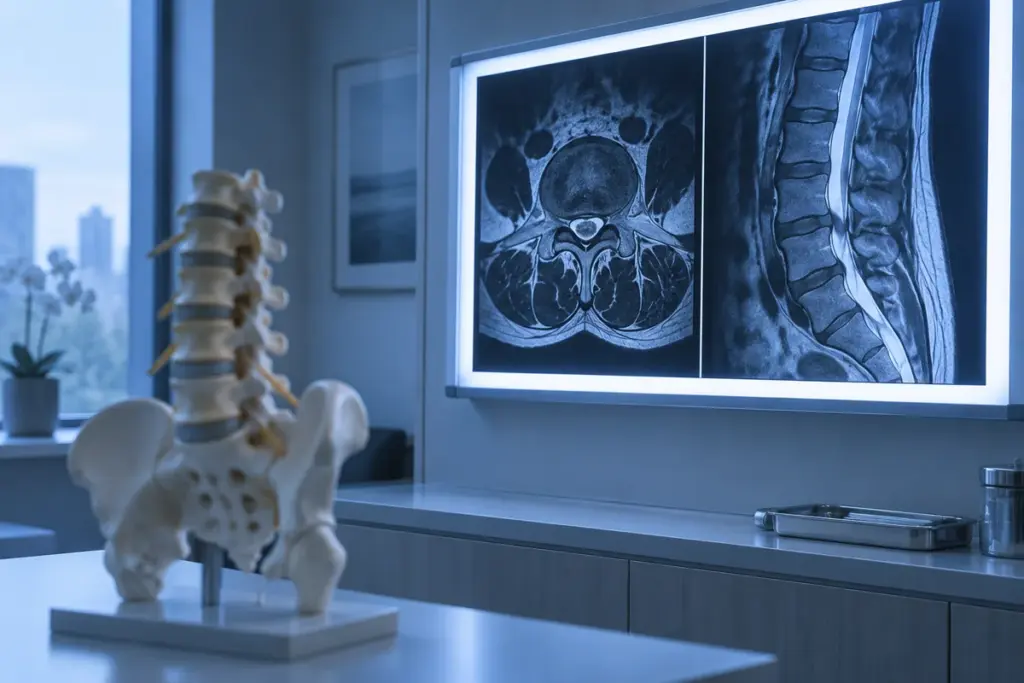
An MRI scan is the main imaging test for spinal stenosis, because it shows the discs, ligaments and nerves clearly. Occasionally, a CT scan, standing X-rays or nerve conduction studies are added when the picture is unclear. However, a scan is only one part of the picture. Narrowing is commonly seen on the scans of older adults who have no symptoms at all, so results must always be interpreted alongside your history and examination.
Treatment Options, From Exercise to Surgery
Treatment depends on how severe your symptoms are, how far you can walk, your general health and how much the condition affects your life. Most people begin with non-surgical care, and many never need an operation.
Non-Surgical Care
NHS Fife’s patient information describes several options, including pain relief, forward-bending exercises where these are tolerated, and walking aids following a physiotherapy assessment. A physiotherapist can also design a programme to strengthen the trunk and hips and gradually build walking distance. In addition, practical adjustments help, such as using a trolley or walking poles that allow a slightly forward posture, breaking walks into shorter sections, and keeping to a healthy weight.
Spinal Injections
When leg pain is the main problem, an image-guided epidural or nerve root injection may be considered. Such injections can ease pain for a period, which may make it easier to progress with exercise and rehabilitation. They can also help confirm which nerve is responsible. Relief is often temporary, so injections usually form part of a wider plan rather than a treatment on their own.
Decompression Surgery
Surgery may be recommended when symptoms persist despite other treatment, when walking distance is severely limited, or when weakness is progressing. The aim of lumbar decompression is to enlarge the space around the nerves so that they are no longer under pressure. Where appropriate, this can be performed using minimally invasive (keyhole) techniques, and occasionally the spine also needs to be stabilised.
Published NHS information gives a useful guide to what to expect. NHS Fife’s leaflet reports that decompression surgery improves symptoms in around 70% of people. According to the Royal Berkshire NHS Foundation Trust, the operation is mostly performed to improve leg symptoms, and patients normally stay in hospital for one to three days. The same leaflet lists the risks, which include deep infection in around 1 in 100 people, superficial wound infection in around 4 in 100, and the need for further surgery within ten years in around 1 in 10. Your surgeon will discuss the risks that apply to you before any decision is made.
When to Seek Emergency Help
Rarely, severe pressure on the nerves at the base of the spine causes cauda equina syndrome, which needs urgent hospital treatment. The NHS advises going to A&E or calling 999 if you have symptoms in both legs, weakness or numbness in both legs that is severe or getting worse, numbness around your genitals or back passage, or any loss of control over your bladder or bowels.
Common Questions About Spinal Stenosis
Is walking safe if I have spinal stenosis?
Yes. Walking is generally encouraged and does not damage the spine. Many people find it easier in shorter, repeated walks, or with a trolley or walking poles that allow them to lean forward slightly. A physiotherapist can help you build a sensible, gradual plan.
How is spinal stenosis different from sciatica?
Sciatica usually describes nerve pain running down one leg, often from a slipped disc, and it may be present much of the time. Spinal stenosis, by contrast, more typically causes symptoms in both legs that come on with walking or standing and ease with sitting. The two can, however, overlap.
How soon can I return to work after decompression surgery?
It depends on your job and your recovery. The Royal Berkshire NHS Foundation Trust advises that people in light work may return after around two weeks if progress is good, while those in heavy manual work may need several months.
Walk Further, With Confidence
Spinal stenosis can quietly reshape daily life, yet it is very manageable once it has been correctly diagnosed and matched to the right treatment, whether that is a structured exercise programme, a targeted injection or decompression surgery. If leg or arm symptoms are limiting your walking, your sleep or your independence, a clear diagnosis is the most valuable first step. Dr. Purnajyoti Banerjee sees patients at The Harley Street Hospital and LIPS Healthcare in Battersea. Book a consultation with Dr. Banerjee
