
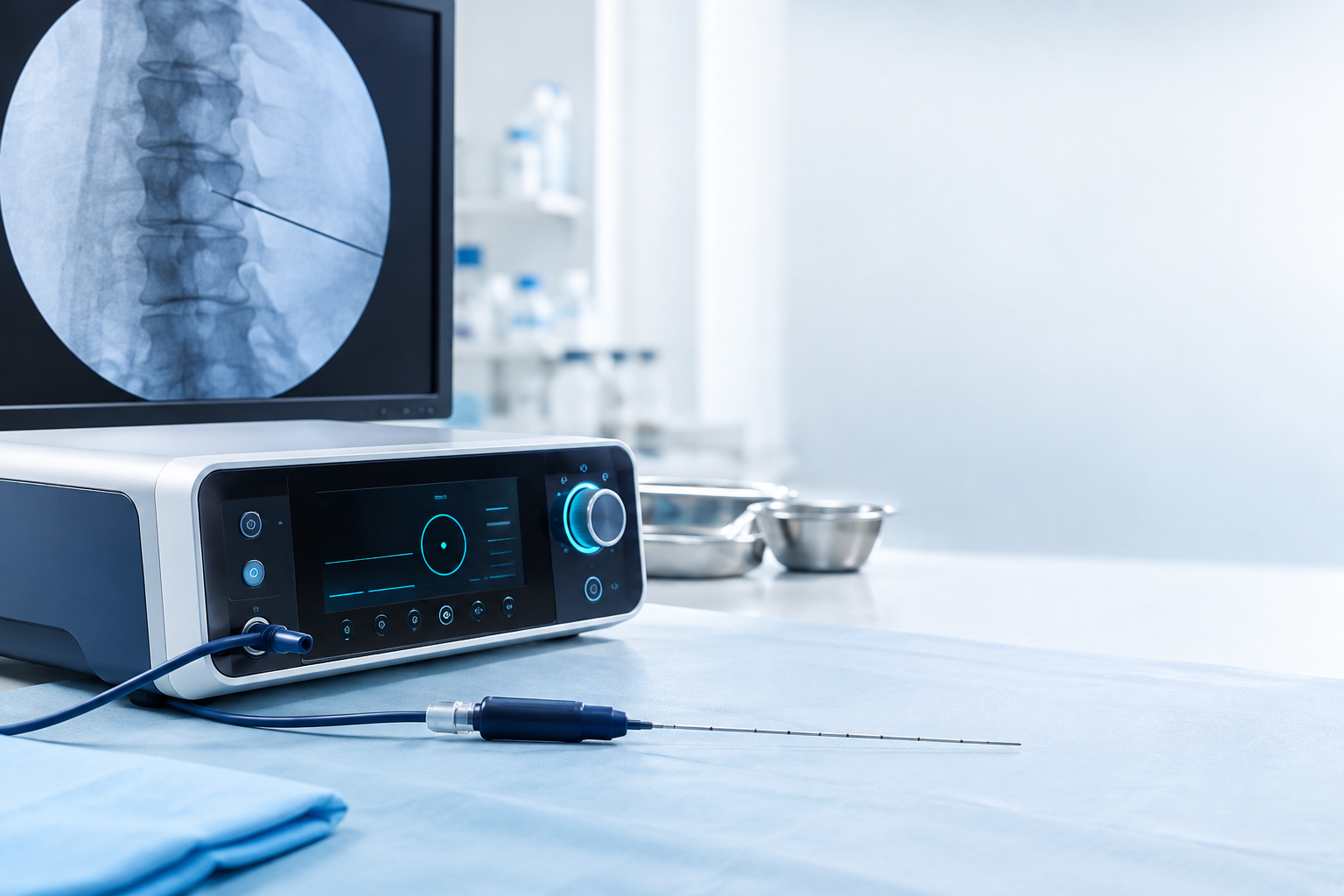
What is Radiofrequency Ablation? A Consultant Orthopaedic Spine Surgeon's Guide
Radiofrequency Ablation, also known as radiofrequency denervation, is a day-case procedure that treats facet joint pain in the neck or lower back by using heat to interrupt the small nerves that carry pain signals from those joints. Under X-ray guidance, a fine needle delivers radiofrequency energy to the medial branch nerves, calming the pain without any open surgery. Dr. Purnajyoti Banerjee, a Consultant Orthopaedic Spine Surgeon in London, offers radiofrequency ablation at his Harley Street clinic, usually after a diagnostic medial branch block has confirmed the facet joints as the source of pain. NICE guidance on low back pain and sciatica supports considering radiofrequency denervation for people with chronic low back pain when non-surgical treatment has not adequately helped, when the pain is thought to come from structures supplied by the medial branch nerves, and when a diagnostic nerve block has produced a good short-term response.
Who Needs Radiofrequency Ablation in London?
- Facet joint pain in the neck or lower back confirmed on assessment
- Pain that returns after a successful medial branch block
- Back or neck pain not settling with physiotherapy, medication or injections
- A preference for longer-lasting relief without open surgery
- Pain that is worse on bending backwards, twisting or standing
Radiofrequency Ablation: The Procedure, Step by Step
Assessment & confirmation
A diagnostic medial branch block confirms the facet joints as the source of pain before ablation is planned
Positioning & anaesthetic
Lying face-down, or with the neck supported, the skin is numbed with local anaesthetic, with optional sedation
Guided access
Under X-ray guidance, a fine needle is placed precisely at the medial branch nerves
Targeted treatment
Radiofrequency energy gently heats the nerve to interrupt the pain signals
Recovery
No incision is needed, so most patients rest briefly and go home the same day
Radiofrequency Ablation Recovery Timeline
Day 0
Home the same day; some local soreness is normal
Weeks 1–2
A short-lived increase in pain can occur before it settles
Weeks 3–6
Relief typically builds as the treated nerves settle
Months 2+
Relief often lasts many months; the procedure can be repeated if pain returns
Radiofrequency Ablation Risks & Considerations
As with any spinal procedure, there are some risks, including temporary soreness, a short-lived increase in pain, a small risk of infection or bleeding, and, uncommonly, temporary numbness or weakness. Relief varies between patients and is not guaranteed, and because the treated nerves can gradually regrow, the procedure sometimes needs to be repeated. Dr. Banerjee discusses all of this openly before you decide.