

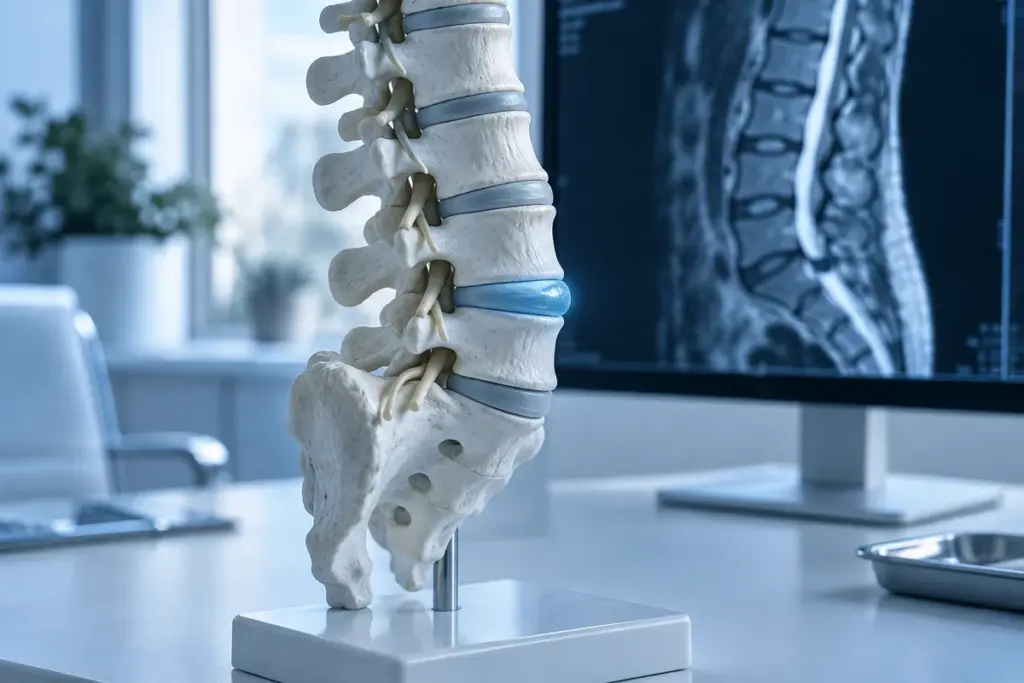
Slipped disc treatment in the lower back rarely begins with an operation. For most people, recovery comes through staying active, effective pain relief and physiotherapy, with injections or surgery kept for the smaller group whose leg pain persists or whose nerves begin to weaken. A slipped disc can be intensely painful, but the outlook is usually far better than the name suggests.
This is the approach that guides the practice of Dr. Purnajyoti Banerjee, a Consultant Orthopaedic Spine Surgeon with more than 20 years of experience in the UK, Germany and India. He trained in complex spine surgery at St George’s Hospital, London, and in minimally invasive and endoscopic techniques as an AOSpine fellow in Germany. At The Harley Street Hospital and LIPS Healthcare, Battersea Power Station, his first aim is to help patients recover without surgery wherever that is realistic.
What Actually Happens When a Disc Slips?
The discs between the vertebrae act as cushions. Each has a tough outer ring and a softer, gel-like centre. In a so-called slipped disc, more accurately a disc prolapse or herniation, part of that softer centre pushes out through a weak point in the outer ring. The disc does not move out of position, which is why clinicians prefer the medical terms.
In the lower back, most disc prolapses occur at the lowest levels of the spine, where the load is greatest. If the displaced material presses on or inflames a nearby nerve root, the result is sciatica: pain, tingling or numbness travelling down the leg. Over time, the body often reabsorbs the displaced disc material, and the NHS notes that a slipped disc usually improves gradually with gentle exercise and pain relief.
Which Symptoms Point to a Slipped Disc?
The symptoms depend on which nerve is affected and how much inflammation surrounds it. Lower back pain is common, but in many people the leg pain is the more distressing feature, often described as sharp, burning or electric and reaching the buttock, thigh, calf or foot. Pins and needles, numbness or a feeling of heaviness in one leg may follow, and some people notice weakness, such as difficulty lifting the front of the foot or pushing off when walking. Sitting, bending or coughing often makes the pain worse.
The NHS lists several factors that make a slipped disc more likely, including ageing, lifting objects incorrectly, sitting or driving for long periods, inactivity, being overweight and smoking. Often, however, there is no single clear trigger. Disc bulges are also frequently seen on scans of people who have no pain at all, which is why imaging must always be interpreted alongside the symptoms and examination.
How Is a Lumbar Disc Prolapse Diagnosed?
A careful history and neurological examination come first. By testing muscle power, reflexes, sensation and nerve tension, a spine specialist can usually identify the affected nerve level before any scan is requested. NICE guideline NG59 advises against routine imaging for low back pain in non-specialist settings, because early scans often show incidental changes that do not explain the symptoms and can cause unnecessary worry.
An MRI scan becomes valuable when pain is severe or persistent, when there is weakness or numbness, or when an injection or surgery is being considered. It shows the discs and nerves in detail, whereas an X-ray shows bone only and has a limited role in diagnosing a disc prolapse.
What Does Slipped Disc Treatment in the Lower Back Involve?
Slipped disc treatment in the lower back works best as a stepped plan, with each stage aiming to settle the irritated nerve, restore movement and protect the spine for the future. Most patients recover in the early stages and never need the later ones.
The foundation is staying active. Prolonged bed rest is no longer recommended, and the NHS encourages a gradual return to gentle exercise such as walking, swimming or yoga. Pain relief supports this, but medicines should be chosen carefully: NICE advises against paracetamol alone for low back pain and against opioids for long-standing sciatica, so it is sensible to agree the right option with a GP or specialist. A structured physiotherapy programme then rebuilds strength, flexibility and confidence in movement.
Can a Spinal Injection Help?
When leg pain is severe and slow to settle, an image-guided epidural or nerve root injection may be considered, and NICE supports considering an epidural injection of local anaesthetic and steroid for acute and severe sciatica. The injection places anti-inflammatory medication close to the irritated nerve. It does not repair the disc, and a 2020 Cochrane review found that it probably reduces leg pain slightly in the short term. Its real value is often in easing pain enough for physiotherapy and normal activity to progress.
When Does Surgery Become the Right Choice?
Surgery is never the automatic next step, and the decision is always made together with the patient. The NHS notes that surgery is not usually needed, but a specialist opinion is appropriate when symptoms have not improved with other treatments or when muscle weakness or numbness is getting worse. NICE advises considering spinal decompression for sciatica when non-surgical treatment has not improved pain or function and the scan findings match the symptoms. Surgery is most reliable for relieving leg pain and is far less predictable for back pain alone.
The most common operation is a microdiscectomy, in which the disc fragment pressing on the nerve is removed through a small incision using magnification and fine instruments. Where the spinal canal is also narrowed, a wider decompression may be advised. Like any operation, it carries risks, including infection, bleeding, nerve injury and the possibility of the disc prolapsing again, and these are discussed in detail beforehand. A Dutch randomised trial published in the New England Journal of Medicine in 2007 found that early surgery relieved leg pain more quickly than prolonged conservative care, although outcomes at one year were similar. Timing, therefore, depends on the severity of the pain, its effect on daily life and the patient’s own preferences.
Which Symptoms Need Emergency Care?
Rarely, a large disc prolapse compresses the bundle of nerves at the base of the spine, a condition called cauda equina syndrome. It is a surgical emergency. The NHS advises calling 999 or going to A&E if back pain is accompanied by numbness around the back passage or genitals, difficulty passing urine, loss of bladder or bowel control, or loss of feeling in one or both legs. These symptoms should never wait for a routine appointment.
Can a Slipped Disc Return?
A disc can prolapse again, and no approach removes the risk completely. Staying physically active, keeping the trunk and hips strong, lifting with the legs rather than the back, avoiding lifting while twisting, breaking up long periods of sitting, maintaining a healthy weight and stopping smoking all address the risk factors recognised by the NHS.
Your Slipped Disc Questions, Answered
Can a slipped disc in the lower back heal on its own?
Often, yes. The displaced disc material frequently shrinks as inflammation settles, and many people recover with time, activity, pain relief and physiotherapy. Pain that is not improving, or any new weakness, should prompt a medical review.
Should I rest or keep moving?
Keep moving within comfort. Prolonged bed rest is no longer advised, and gentle activity such as walking helps reduce stiffness. Heavy lifting and repeated bending are best avoided in the early, painful phase, with activity then built up gradually.
Do I need an MRI scan before treatment starts?
Not always. Many disc bulges are incidental findings, so a scan is most useful when symptoms are severe or persistent, when there is weakness or numbness, or when an injection or surgery is being considered.
How long does recovery from microdiscectomy take?
Relief of leg pain is often noticed early, while numbness and strength may take longer to recover. The length of the hospital stay and the time before returning to work depend on the individual and the type of work, and your surgeon will give personal advice.
Taking the Next Step Towards Recovery
A slipped disc can disrupt sleep, work and family life, yet for most people it is a condition that improves with the right plan. Injections and surgery remain available for those whose pain or nerve symptoms do not settle, and the key to choosing well is an accurate diagnosis based on the symptoms and examination rather than the scan alone. If lower back pain or sciatica is holding you back, Dr. Purnajyoti Banerjee will assess you thoroughly at The Harley Street Hospital or LIPS Healthcare, Battersea Power Station, and explain every suitable option clearly.
