

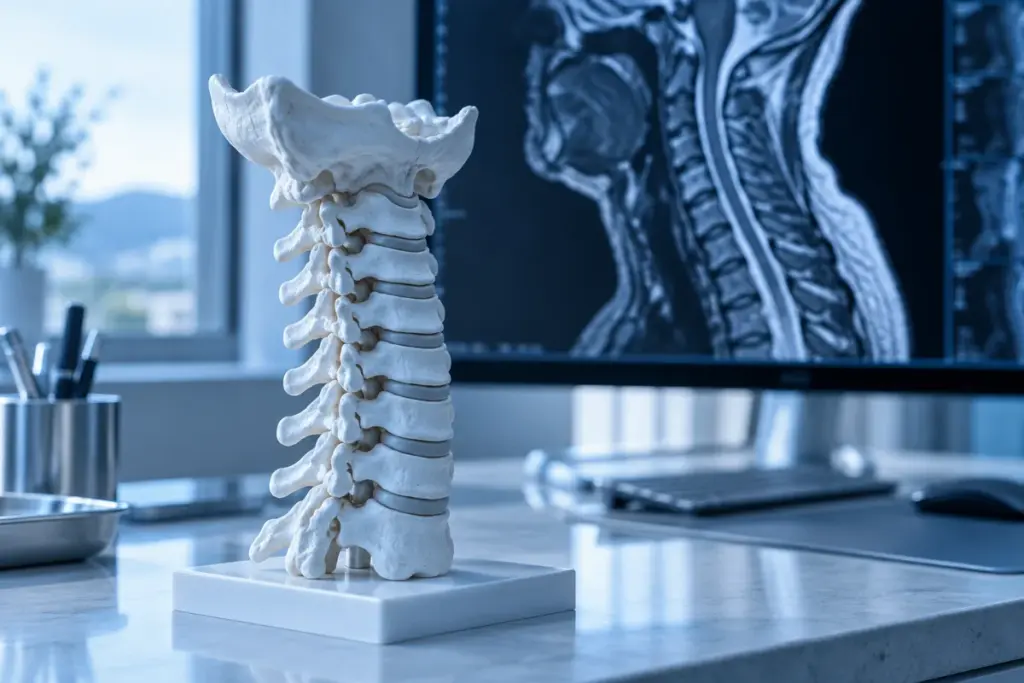
Cervical radiculopathy symptoms usually begin in the neck but are felt most clearly in the arm: a sharp or burning pain that travels towards the hand, often with pins and needles, numbness or weakness. The cause is a nerve root in the neck that has become compressed or irritated, most often by a disc or by age-related wear. The encouraging news is that most people improve without surgery. The skill lies in recognising the pattern early and knowing which signs need a specialist.
Dr. Purnajyoti Banerjee is a Consultant Orthopaedic Spine Surgeon in London, holding the FRCS (Trauma & Orthopaedics) from the Royal College of Surgeons of England. He completed a complex spine fellowship at St George’s Hospital, London, and an AOSpine fellowship in Germany focused on minimally invasive and endoscopic spine surgery. He sees patients at The Harley Street Hospital and LIPS Healthcare, Battersea Power Station. In every consultation, he begins with an accurate diagnosis and non-surgical care, and recommends surgery only when it is clearly justified.
What Do Cervical Radiculopathy Symptoms Feel Like?
The defining feature of cervical radiculopathy is pain that travels. Instead of staying in the neck, it follows the course of the affected nerve across the shoulder blade and down the arm, sometimes reaching particular fingers. Patients often describe it as sharp, electric or burning, and the arm pain is frequently more troublesome than the neck pain itself.
The most commonly reported symptoms are:
- neck pain or stiffness, often with aching over the shoulder blade
- arm pain running in a narrow band rather than spreading evenly
- pins and needles, tingling or numbness in the forearm, hand or fingers
- weakness when lifting the arm, gripping or holding objects
Symptoms usually affect one side only. They may worsen when coughing, sneezing or tilting the head towards the painful side, and some people find relief by resting the hand on top of the head, a position that eases tension on the nerve. Sleep is often disturbed. The onset can be sudden, after an awkward movement, or gradual over several weeks with no obvious trigger.
Why Does a Nerve in the Neck Become Trapped?
The cervical spine is made up of seven vertebrae, and nerve roots leave the spinal canal through small openings on each side. Anything that narrows one of these openings, or presses directly on a nerve root, can produce cervical radiculopathy symptoms. The NHS lists a pinched nerve among the recognised causes of neck pain, and in everyday language the condition is often called a trapped nerve in the neck.
In younger adults, the cause is commonly a disc prolapse, in which the soft inner part of a disc bulges outwards and irritates the nerve root. The pain tends to come on quickly and can be intense, as inflammation plays a large part. In many cases, the body gradually reabsorbs the displaced disc material, which is one reason non-surgical treatment is normally tried first.
In older adults, the cause is more often cervical spondylosis, the gradual wear of the discs and joints of the neck that comes with age. Discs lose height and small bony spurs form, slowly narrowing the space available to the nerve. Symptoms in this group often build gradually and may come and go. Less commonly, the problem follows a neck injury, and rarely another spinal condition needs to be excluded, which is why careful clinical assessment matters more than a scan alone.
Can the Pattern of Symptoms Show Which Nerve Is Affected?
Often, yes. Each nerve root supplies a recognisable strip of skin and a particular group of muscles, so the location of the pain and tingling points towards the level involved. A C5 nerve root problem typically causes pain around the shoulder and upper outer arm, with weakness when lifting the arm out to the side. A C6 root refers symptoms along the outer forearm into the thumb and index finger. A C7 root affects the back of the arm and the middle finger and can weaken elbow straightening, while a C8 root involves the little-finger side of the hand and grip strength.
These patterns overlap, so they guide the diagnosis rather than confirm it. Carpal tunnel syndrome, nerve compression at the elbow and shoulder conditions can all produce similar arm and hand symptoms, and telling them apart is one of the main purposes of a specialist examination.
When Should Neck and Arm Pain Be Assessed by a Doctor?
The NHS advises seeing a GP if neck pain has not improved after a few weeks, or if there are pins and needles or a cold feeling in the arm. A specialist opinion is worth considering if arm pain is severe, persistent or interfering with sleep and work, or if any weakness is developing.
Some symptoms suggest that the spinal cord itself, rather than a single nerve root, may be under pressure. This condition, known as cervical myelopathy, needs timely specialist review. Warning signs include clumsiness of the hands, such as difficulty with buttons or handwriting; numbness affecting both hands; problems with balance or a feeling of heaviness in the legs; and changes in bladder or bowel control. Neck pain accompanied by fever, unexplained weight loss or a previous history of cancer also warrants prompt medical assessment. If weakness comes on suddenly or is rapidly worsening, seek urgent medical help through A&E.
How Is Cervical Radiculopathy Diagnosed?
Diagnosis begins with a detailed history, because the distribution and behaviour of the symptoms often identify the affected nerve root before any scan is arranged. Examination then assesses neck movement, muscle strength, reflexes and sensation in both arms. Certain gentle neck positions that narrow the nerve opening may reproduce the arm pain, which supports the diagnosis.
An MRI scan is the main investigation when symptoms persist or when there are signs of nerve weakness, as it shows the discs, nerve roots and spinal cord in detail. Nerve conduction studies may be added when the picture is unclear, for example when carpal tunnel syndrome is also suspected. MRI scans frequently show age-related changes in people who have no symptoms at all, so a scan is only meaningful when it matches the clinical findings. Dr. Banerjee places particular emphasis on this correlation before recommending any treatment.
Which Treatments Help Cervical Radiculopathy Symptoms?
Treatment depends on how severe the symptoms are, how long they have lasted and whether nerve function is affected. For most people, the first step is conservative care. This means staying gently active and keeping the neck moving within comfort, using appropriate pain relief agreed with a clinician, and following a physiotherapy programme to restore movement and strength. Adjusting screen height and taking regular breaks from sustained head-down positions can also reduce strain. The NHS advises against wearing a neck collar, as it is better to keep the neck moving.
When arm pain remains difficult to control despite these measures, an image-guided nerve root or epidural injection may be considered. The aim is to reduce inflammation around the irritated nerve and ease pain enough for rehabilitation to progress. An injection can also help confirm which nerve is responsible for the symptoms.
Surgery is discussed when pain stays disabling after an adequate period of non-surgical treatment, or when there is significant or progressive weakness, or signs of spinal cord compression. The purpose of surgery is to relieve pressure on the nerve. Depending on the cause and level, this may involve removing the disc from the front of the neck and stabilising the segment, replacing the disc with an artificial disc, or widening the nerve opening from the back of the neck. Each approach has its own benefits, risks and recovery, and the right choice depends on the individual findings. The British Association of Spine Surgeons offers further patient information on spinal conditions and surgery.
What Does Recovery Usually Look Like?
Recovery varies from person to person. Arm pain is often the first symptom to ease, while tingling and numbness can take longer to settle because nerves heal slowly. Where weakness is present, strength typically returns gradually over several months. Steady progress, rather than a sudden change, is the usual pattern, and regular review allows the treatment plan to be adjusted along the way.
Keeping the neck and shoulder muscles strong, varying posture through the day, setting screens at eye level and staying physically active are sensible measures that support recovery and help protect the neck in the longer term.
Questions Patients Often Ask About Cervical Radiculopathy
Is cervical radiculopathy the same as a trapped nerve in the neck?
Yes. A trapped nerve in the neck is the everyday term for compression or irritation of a cervical nerve root. Both describe the same problem and the resulting pain, tingling, numbness or weakness in the arm.
Can cervical radiculopathy improve without surgery?
In most cases, yes. The majority of people improve with time, physiotherapy, pain relief and, where necessary, a targeted injection. Surgery is generally reserved for persistent disabling pain, significant or worsening weakness, or spinal cord compression.
Which scan is used to diagnose cervical radiculopathy?
MRI is the main scan, as it shows the discs, nerve roots and spinal cord clearly. Its findings are always interpreted alongside the history and examination, because age-related changes are common in people without symptoms.
Should a neck collar be worn?
The NHS advises against wearing a neck collar for neck pain, as keeping the neck gently moving is more helpful. A specialist may advise otherwise only in specific circumstances, such as after certain injuries or operations.
Seeking Clarity About Your Neck and Arm Pain?
Pain that travels from the neck into the arm can be distressing, particularly when it disturbs sleep or affects grip and dexterity. A precise diagnosis is the foundation of good treatment: identifying which nerve is involved, excluding other causes of arm symptoms and matching care to the individual rather than to the scan alone. Dr. Purnajyoti Banerjee offers consultations at The Harley Street Hospital and LIPS Healthcare, Battersea Power Station, where he will explain your findings clearly and discuss every appropriate option, from physiotherapy and injections to surgery when it is genuinely needed.
