

For many years, reaching the spine meant a long incision and lifting the supporting muscles away from the bone. Today, many spinal operations can be carried out through a much smaller opening, using specialised instruments, magnification and live X-ray guidance. Understanding the benefits of minimally invasive spine surgery, and its limits, can help you approach a conversation with a surgeon with confidence.
In brief, the benefits of minimally invasive spine surgery, often called keyhole spine surgery, can include smaller incisions, less disruption to the muscles around the spine and less blood loss. A 2022 review of the research also found shorter hospital stays and fewer complications compared with open surgery. However, it is not suitable for every patient or every condition, and the right choice depends on careful assessment.
Dr. Purnajyoti Banerjee is a Consultant Orthopaedic Spinal Surgeon whose training has focused on advanced spinal techniques. He holds the FRCS in Trauma and Orthopaedics from the Royal College of Surgeons of England, an MSc in Trauma and Orthopaedics, MRCS (Edinburgh) and DipSICOT, and completed a Complex Spine Fellowship at St George’s Hospital, London, and an AOSpine Fellowship in Germany. With more than 20 years of orthopaedic experience, he sees patients at The Harley Street Hospital and LIPS Healthcare in Battersea, and offers keyhole spinal surgery alongside non-surgical treatments such as image-guided spinal injections.
How Keyhole Spine Surgery Works
Minimally invasive spine surgery is not a single operation. Rather, it is a group of techniques that aim to achieve the same result as traditional open surgery, such as relieving pressure on a trapped nerve or stabilising a painful segment of the spine, through a smaller access route.
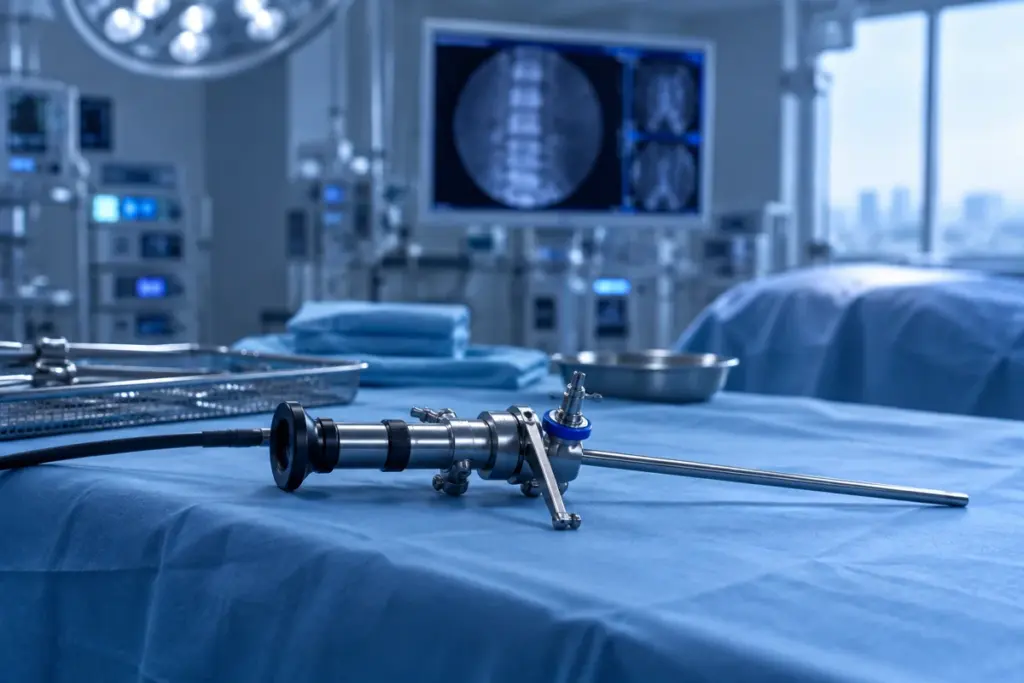
Instead of stripping the muscles away from the bone, the surgeon gently widens a path between the muscle fibres and works through a narrow tube. A high-powered microscope or a small camera (endoscope) gives a magnified view of the nerves and discs. Meanwhile, live X-ray imaging confirms the exact level of the spine and the position of the instruments. Where the spine needs to be stabilised, screws can sometimes be placed through small incisions in the skin.
Procedures commonly performed in this way include microdiscectomy for a slipped disc, decompression for spinal stenosis, and selected fusion operations.
What Does the Evidence Show?
The advantages of keyhole surgery come mainly from what the surgeon does not need to disturb. A 2022 systematic review and meta-analysis published in the European Spine Journal compared minimally invasive and open surgery for degenerative conditions of the lower spine. It found that minimally invasive surgery led to:
- Less blood loss during the operation
- A slightly shorter hospital stay
- A lower risk of complications
Importantly, the same review found no significant difference between the two approaches in improvements in disability scores. In other words, keyhole surgery may offer a gentler recovery, while long-term results in suitable patients appear broadly similar to open surgery.
Why Less Muscle Disruption Matters
The muscles alongside the spine help to support it. In open surgery, these muscles are lifted away from the bone, which is one reason some patients have prolonged discomfort afterwards. By working between the muscle fibres, keyhole techniques largely preserve this support. This may make it easier for some patients to get moving after surgery, and the scars are smaller, although appearance is rarely the main reason for choosing this approach.
Which Conditions Can Keyhole Surgery Treat?
It is worth stating clearly that most back and neck pain does not need surgery. The NHS notes that surgery for a slipped disc is not usually needed, and is only discussed when symptoms have not improved with other treatments, or when there is worsening weakness or numbness. When surgery is appropriate, keyhole techniques may be suitable for the following conditions.
Slipped Disc and Sciatica
When a disc presses on a nerve root in the lower back, leg pain, numbness or weakness can become the main problem. If these symptoms persist despite non-surgical treatment, a minimally invasive microdiscectomy may be discussed. This removes the part of the disc pressing on the nerve, with the aim of relieving the leg symptoms.
Spinal Stenosis
Narrowing of the spinal canal typically causes heavy, aching legs and a reduced walking distance. Minimally invasive decompression can enlarge the space for the nerves while preserving more of the surrounding ligaments and joints. The aim is to improve walking tolerance, although back pain that was present beforehand may not resolve completely.
Problems in the Neck
Disc problems in the neck can cause arm pain, pins and needles or weakness. Some cases are suitable for a less invasive operation from the back of the neck, while others are better treated from the front. The best approach depends on exactly where the pressure on the nerve lies and on the overall alignment of the neck.
Who Is Suitable for Minimally Invasive Spine Surgery?
The benefits of minimally invasive spine surgery depend heavily on choosing the right patient for the right procedure. For this reason, a thorough assessment always comes first.
This begins with a detailed conversation about your symptoms: where they are felt, how long they have lasted, how far you can walk, whether pain disturbs your sleep, and whether you have noticed any change in bladder or bowel function. An examination then checks muscle strength, reflexes, sensation and the way you walk. Imaging, most often an MRI scan, shows whether there is a structural cause that matches your symptoms. Sometimes a CT scan or standing X-rays are added to assess alignment and stability.
Just as importantly, non-surgical options are considered first. These may include physiotherapy, changes to daily activities and, in some cases, image-guided spinal injections, which can ease nerve irritation and help confirm which level of the spine is responsible for the symptoms. Surgery is generally discussed only when these measures have not given enough relief, or sooner if weakness is progressing.
What Are the Limits and Risks?
Keyhole surgery offers real benefits, but they are not universal. Large deformities, instability across several levels of the spine, complex repeat operations, and certain infections or tumours may need a conventional open approach to achieve a safe and lasting result.
It is also important to understand that a smaller incision does not remove the risks of spinal surgery. For lumbar decompression, the NHS lists serious but uncommon complications, including a leak of spinal fluid that may require further surgery, damage to the spinal nerves, back pain that does not improve, and vertebrae moving out of place after surgery. As with any operation, there are also general risks such as infection, bleeding, blood clots and reactions to anaesthesia. Your surgeon should explain how these apply to you before any decision is made.
Working through a narrow tube also requires specific training and experience. If you are considering keyhole surgery, it is entirely reasonable to ask your surgeon about their training and experience with the procedure being recommended.
What Is Recovery Like?
Recovery varies with the procedure, your age and general health, and the type of work you do. As a general guide, the NHS states that after lumbar decompression surgery, people may leave hospital after around two to five days, may return to work after around four to six weeks, and may take up to 12 weeks to return to all their usual activities. The European Spine Journal review found that minimally invasive approaches shortened hospital stays slightly compared with open surgery, although individual recovery always differs.
In the early weeks, short and frequent walks are usually encouraged rather than long periods of sitting. Following the physiotherapy plan you are given, avoiding heavy lifting and twisting, and reporting any fever, increasing pain, wound discharge or new weakness promptly all help recovery go smoothly.
Questions Worth Asking Before Surgery
Feeling well informed is an important part of making the right decision. Before agreeing to any spinal operation, you may wish to ask:
- What is causing my symptoms, and how certain is the diagnosis?
- Have the non-surgical options been fully explored?
- Is a minimally invasive approach suitable for my condition, and why?
- What improvement can I realistically expect, particularly in leg pain compared with back pain?
- What are the risks for me, and how often do they occur?
- How long will I be in hospital, and when can I return to work and driving?
- What experience do you have with this procedure?
A good consultation should leave you with clear answers to each of these questions. The British Association of Spine Surgeons also provides independent information for patients considering spinal treatment.
Is Keyhole Spine Surgery Right for You?
Minimally invasive techniques have changed what recovery after spinal surgery can look like for many people, offering less disruption and, for suitable patients, a quicker return to everyday life. Even so, they are one option among several, and the most valuable first step is an accurate diagnosis. Dr. Purnajyoti Banerjee assesses patients at The Harley Street Hospital and LIPS Healthcare in Battersea, beginning with non-surgical options and recommending surgery only when it is genuinely likely to help. Request a consultation to discuss your options.
