

A sharp pain runs down the back of your thigh. Your calf tingles when you sit for too long. Yet your back feels perfectly fine. It is easy to assume a pulled hamstring or a circulation problem, and to wait for it to pass. Many people are surprised to learn that the cause may lie in the spine after all.
So, can you have sciatica without back pain? Yes, you can. Sciatica describes pain, numbness, tingling or weakness caused by irritation or compression of the sciatic nerve or the nerve roots that form it. Because the problem lies in the nerve rather than in the muscles or joints of the back, symptoms are often felt only in the buttock, thigh, calf or foot.
Dr. Purnajyoti Banerjee is a Consultant Orthopaedic Spinal Surgeon in London, with more than 20 years of orthopaedic experience gained across the UK, Germany and India. He is a Fellow of the Royal College of Surgeons of England in Trauma and Orthopaedics, and completed a Complex Spine Fellowship at St George’s Hospital, London, followed by an AOSpine Fellowship in Germany. He sees patients at The Harley Street Hospital and LIPS Healthcare in Battersea. His approach is to explore non-surgical treatment first and to recommend surgery only when it is genuinely needed.
What Is Sciatica?
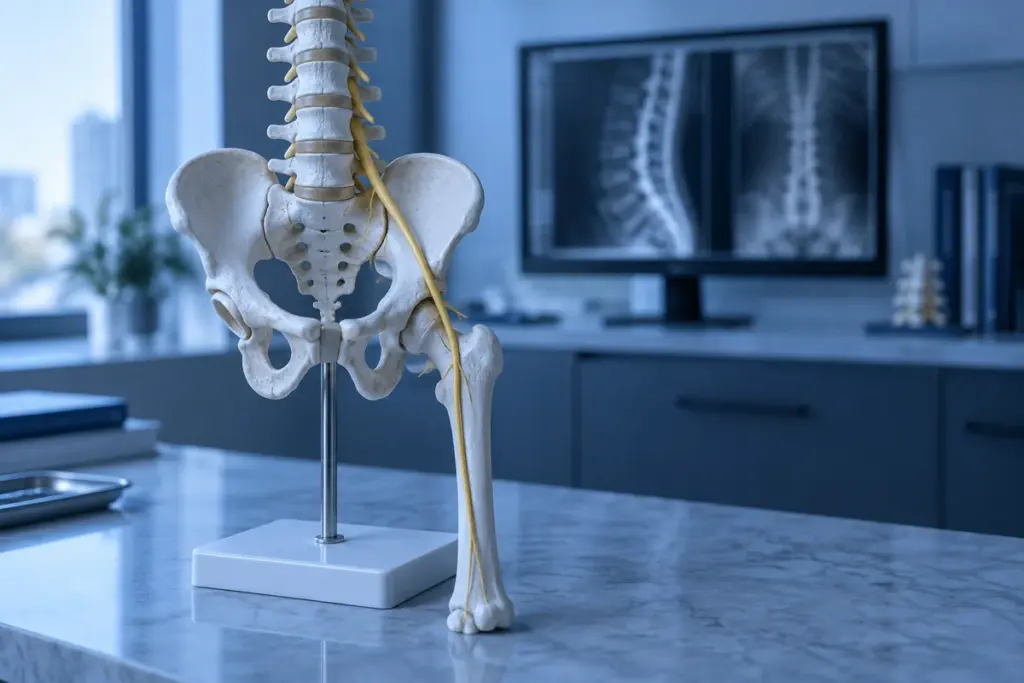
The sciatic nerve is the longest nerve in the body. It is formed from nerve roots in the lower spine, runs through the buttock and down the back of the thigh, and then divides below the knee to supply the calf, shin and foot.
Sciatica is not a diagnosis in itself. Rather, it is a set of symptoms pointing to a cause somewhere along that pathway. When a nerve root is compressed or inflamed, the brain interprets the signal as coming from the area that nerve supplies. This is why the pain is often felt in the leg rather than at the site of the problem.
What Causes Sciatica?
According to the NHS, the most common cause of sciatica is a slipped disc, in which the soft centre of a spinal disc presses on a nearby nerve root. Other causes include narrowing of the spinal canal (spinal stenosis), a vertebra slipping forward onto the one below (spondylolisthesis), age-related wear in the discs and joints of the spine, and injury. Less commonly, infection, inflammation or a growth can be responsible.
Why Can Sciatica Occur Without Back Pain?
Back pain and leg pain usually come from different structures. Back pain tends to arise from pain-sensitive tissues such as the outer wall of the disc, the small facet joints, ligaments and muscles. Leg symptoms, by contrast, come from the nerve root itself.
If a disc bulge presses on a nerve without significantly irritating those pain-sensitive structures, the result can be leg pain alone. Similarly, in spinal stenosis, the nerves are squeezed gradually rather than injured suddenly. As a result, many people describe heaviness, cramping or burning in the legs when walking, while their back feels comfortable at rest.
Importantly, the amount of back pain does not reliably reflect how much a nerve is being compressed. Some people with a large disc bulge have no back pain at all. For this reason, leg symptoms should never be dismissed simply because the back feels fine.
What Does Sciatica Feel Like?
Nerve pain has a recognisable character. It tends to travel in a line rather than spreading widely, and it often comes with changes in sensation. The NHS describes sciatica as typically affecting one leg, with a sharp or burning pain down the back of the leg, along with tingling, numbness or weakness. The pain may also worsen when moving, sneezing or coughing.
Weakness deserves particular attention. Difficulty lifting the front of the foot, standing on tiptoe or climbing stairs can be a sign that a nerve is under significant pressure, and it should always be assessed by a doctor.
Which Conditions Can Be Mistaken for Sciatica?
Not every leg pain is sciatica. One of the main benefits of a specialist assessment is ruling out conditions that look similar but need quite different treatment.
Hip arthritis, for example, often causes pain in the groin and thigh that stops above the knee, together with stiffness when turning the hip. Problems with the hamstring tendon cause tenderness at the sitting bone, particularly during sprinting or lunging. Irritation of the sciatic nerve deep in the buttock, sometimes linked to the piriformis muscle, can produce similar symptoms without any spinal cause.
Other conditions can also mimic sciatica. Peripheral neuropathy, as seen in diabetes, usually affects both feet evenly. Poor circulation in the legs (peripheral arterial disease) typically causes calf cramping on walking that eases quickly with rest. Irritation of the sacroiliac joint, at the back of the pelvis, can cause pain spreading into the buttock. A careful history and examination usually tell these apart.
How Is Sciatica Diagnosed When the Back Feels Normal?
Diagnosis begins with listening. Where exactly does the pain travel? What makes it better or worse? Is there numbness, and in which part of the foot? Has there been any weakness, or any change in bladder or bowel function? The answers often point to the affected nerve root before any scan is considered.
An examination then assesses posture, walking, reflexes, muscle strength, sensation and nerve tension, including the straight leg raise test. The hip and knee are examined too, because pain spreading from these joints is a common source of confusion.
Do You Need an MRI Scan?
Not always. NICE guidance on low back pain and sciatica (NG59) advises against routine imaging in non-specialist settings, because most episodes improve with time and scans often show changes that are not causing symptoms. An MRI scan becomes more useful when symptoms persist despite treatment, when weakness or numbness is progressing, when the diagnosis is uncertain, or when injections or surgery are being considered. In each case, a scan should answer a specific question rather than be ordered as a matter of routine.
How Is Sciatica Treated?
Most people with sciatica improve without surgery. The NHS notes that sciatica usually gets better within a few weeks to a few months, although it can last longer and may return. Treatment is tailored to the cause, the severity of symptoms and how much they affect daily life.
Treatment Without Surgery
The first step is usually to stay as active as possible. The NHS advises continuing normal activities and gentle exercise, using heat packs, and asking a pharmacist about suitable pain relief. In addition, NICE recommends considering a supervised exercise programme, often guided by a physiotherapist, to improve movement and confidence.
When pain is severe, targeted injections may help. NICE advises considering an epidural injection of local anaesthetic and steroid for people with acute and severe sciatica. These injections are performed under imaging guidance to deliver medicine close to the irritated nerve. Practical changes to sitting, driving and lifting at work can also make a meaningful difference while the nerve settles.
When Is Surgery Considered?
Surgery is reserved for a smaller group of patients. NICE advises considering spinal decompression for sciatica when non-surgical treatment has not improved pain or function, and when scan findings match the symptoms. Surgery may also be discussed sooner if weakness is significant or getting worse.
Procedures such as microdiscectomy or decompression aim to relieve pressure on the affected nerve root. Where appropriate, minimally invasive (keyhole) techniques can reduce disruption to surrounding tissue. As with any operation, the benefits, risks and realistic expectations should be discussed in detail before any decision is made.
When Is Sciatica an Emergency?
Rarely, pressure on the nerves at the base of the spine causes a serious condition called cauda equina syndrome, which needs urgent hospital treatment. The NHS advises going to A&E or calling 999 if you have sciatica and:
- sciatica on both sides
- weakness or numbness in both legs that is severe or getting worse
- numbness around or under your genitals, or around your back passage
- difficulty starting to pass urine, being unable to pass urine, or being unable to control when you pass urine
- not noticing when you need to open your bowels, or being unable to control your bowels
Frequently Asked Questions
Does sciatica without back pain mean it is less serious?
Not necessarily. The amount of back pain does not reliably reflect how much a nerve is being compressed. What matters more is the pattern of leg symptoms, any numbness or weakness, and whether these are improving, stable or getting worse.
How long does sciatica take to get better?
According to the NHS, sciatica usually improves within a few weeks to a few months, although recovery varies between individuals. If your symptoms persist, worsen or come with weakness, a specialist assessment is advisable.
Is sciatica without back pain treated differently?
No. Treatment focuses on the cause rather than where the pain is felt. The aim is to identify which nerve root is affected and why, and then to choose the most suitable option, whether that is exercise and physiotherapy, an injection or, in some cases, surgery.
Arrange a Consultation With Dr. Banerjee
Leg pain without back pain should never be a reason to delay seeking advice when symptoms are persistent, getting worse or limiting your daily life. A careful assessment can distinguish true nerve compression from hip, circulation or soft tissue problems, and lead to a treatment plan that starts with the least invasive option. To discuss your symptoms with Dr. Purnajyoti Banerjee, Consultant Orthopaedic Spinal Surgeon, at The Harley Street Hospital or LIPS Healthcare in Battersea, please arrange a consultation.
